Wednesday, July 31, 2019

Saturday, October 22, 2016
Is there anybody out there?
It's VeganMoFo in just one week's time. I'm wondering if I should sign up. It's been nearly a year since I last posted but I'd quite like to give it a go. So, is there anybody out there and would you like to read a month of my maunderings if I did?
Actually strike that - the buggers have closed registration. Well, who needs them.
Thursday, January 14, 2016
A fresh taste

In the picture a few spears of the last half-sour fermented cucumbers of the summer, pink pickled turnip, some queen olives and a sprig of celery leaf as garnish.
A trip to a Lebanese restaurant - Al-Shami in Oxford (they seem to be having problems with the web site at the time of writing) reminded me how much I adore middle-eastern pickles. They're cool, quick and crunchy and much less puckery than the classic British pickles even if both are equally delicious.
The other good point is that they are ridiculously easy to make at home. Simply prepare your vegetables and submerge in a boiling brine, close and leave to mature for a few days and then they're done. They will keep in the fridge for a couple of weeks but no more. This isn't likely to be a problem.
The turnip pickles I had at Al-Shami were traditionally pink with beetroot juice, slightly sharp and salty. I ate all the ones on the salad plate and an extra side dish besides along with pickled chillies and olives. The other food was good but these were the best.
Getting turnips at this time of year wasn't terribly easy, the humble turnip seems to be way out of fashion and we had to try several places before tracking them down in Waitrose at a ridiculous price but my need had to be satisfied. A fresh white mooli would make a good substitute if that's all you can find.
For my recipe I mashed up the suggestions of two of my favourite authors on midde-eastern food, Claudia Roden and Arto de Haroutunian. Claudia tells me that in Egypt the pickles are made with no vinegar at all but she uses a very strong brine. I decided that would be too salty. Arto uses quite a lot of vinegar and other aromatics besides. I didn't want a very sharp pickle or to mask the turnip flavour too strongly so like Goldilocks I offer you a middle way but do adapt the recipe to your own taste as any good cook should.
750g peeled turnips
1 beetroot, cooked or raw
1 or 2 peeled cloves of garlic
900g water
100g cider vinegar (5%)
30g salt
Peel your turnips and cut them into pleasing shapes. I love the crinkle cutter for these but slices, wedges, finger shapes are all fine. Don't make them too thick in any direction, less than 1cm is good.
Slice the beetroot up. Raw beets should be quite thin, ready cooked ones a little thicker just to stop them breaking up too much.
Put the prepared turnip and beetroot into a very clean jar. Not much point in sterilising it as the turnip isn't sterile as it goes in but cleanliness is important. I used a square mason jar, about 2 ltrs capacity. This size jar would have taken a few more bits of turnip if you happened to have them. Mix the two vegetables as you go to equally distribute the beetroot throughout the turnips. If you want other flavourings - celery leaf for example or a chilli then now is the time to pop them in.
A word on salt - any salt will do. It's much better to weigh it than use a volume measure like a tablespoon as the grain size varies so much. You get a much heavier weight of fine salt to large crystal sort in the same spoon. Unrefined sea salt will make the brine cloudy and iodised salt (table salt) will make the pickles darker so for this, where the colour is part of the charm, use cooking salt for preference.
Put the water, vinegar and salt into a saucepan and bring to the boil. Add the garlic in slices. I like to 'cook' the garlic like this because I once read an article on botulism but I'm sure it's not all that necessary. As soon as it's boiling and the salt is dissolved pour it over the turnips in the jar and seal the top. Spare brine will keep in a lidded jar in the fridge for a while or you can do as I did and roam the kitchen looking for spare veg that needed an unexpected salt bath.
Keep the sealed jar on the kitchen counter at warm room temperature for a few days - four or five is plenty. You can start eating them after that, taking out portions with a clean spoon each time and keeping the rest in the fridge.
Happy New Year
Sunday, November 08, 2015
Late to the party

This is hardly cutting edge now, the world and his wife have already heard the news about chickpea cooking liquid, renamed by some as the rather fancier aquafaba, and its unusual ability to whip up like egg whites.
I've tried a few times before to create simple meringues but failed each time during the cooking process - it's easy to make a wonderful fluffy white cloud of sweetness, if you have a good food processor to do the necessary whipping, but a crisp shell of loveliness seemed just out of reach.
Still all cooking is a procedure of refinement - I think my first effort failed because I was using a cheap toaster oven with poor temperature control and my second because I'd tried a different proportion of liquid to sugar and the whipped chickpea juice simply couldn't hold the concentration of sugar. The meringues were weeping before they'd had time to set.
Back in the UK with a better oven, precise scales and a desire to ignore each and every recipe that calls for cups of ingredients the formula seems to have been staring me in the face all along.
It's not perfect yet. I do so want to understand why the chickpea juice works as it does. It's a property of legume proteins and sugars which could probably be recreated without the need to use a by-product of cooking pulses, even if there is a sort of analogy with the dividing of yolks and whites in the traditional egg based methods. I particularly don't like using liquid from commercially canned goods but have so far found the extra effort of cooking dried chickpeas just for the cooking broth a bit too much for me. Perhaps now I've made something I'm happy with that step won't seem like such wasted effort.
So without further ado I give the almost 100% perfect method of making vegan meringues. They don't keep very long so make them the day you intend to serve them and keep them very dry in storage.
100g chickpea cooking liquid (aquafaba). This is about the amount you get drained from a 400g tin of chickpeas.
100g fine granulated sugar. I used caster sugar today but granulated will work.
1tsp vanilla essence.
Heat the oven to 100C. Line a baking tray with parchment paper.
Beat the chickpea liquid with an electric rotary whisk, the egg beating attachment of your food processor or (in my rather froopy French processor) the beating plate until it is stiff and shows sharp peaks. This will take some minutes (unless you have the French thing).
Add the vanilla essence and then little by little the sugar while the machine continues working, pausing between each addition to allow the sugar to be absorbed. It will become glossy but should still be very stiff.
When all the sugar is added you're done. It tastes good like this as a creamy marshmallow-like topping or it could be used as a meringue layer for a pie; baked in the oven until nicely browned and squidgy inside. For meringues spoon or pipe the mixture in small mounds on the parchment. It doesn't spread far so they can be fairly close together. You should get 14-16 pieces. If you make them too thick they may not set properly and so if you want a large single cake for a pavlova smooth it down so it's not more than 15mm thick.
Now I really wanted to say "bake for 100 minutes" to complete my 100% theme but the truth is you need to give them at least 150 mins (2.5 hours) at this very gentle temperature to become crisp and fully set. Allow to cool for another 30 minutes in the oven after you turn it off.
Serve with your favourite toppings.
Tuesday, September 22, 2015
Moar courgettes
The season is nearly over and the plan hasn't been very well adhered to. Before it's too late here is my truly favourite way to make a courgette edible and fit for friends and that's griddled.

It's barely a recipe, cut your courgettes into neat slices however you think is most attractive. Don't use any that are too seedy if looks are important, guests expected or anything like that because they tend to fall apart during cooking but otherwise any courgette that still qualifies for the name and hasn't become a marrow will do nicely.

Get the griddle nice and hot and brush a little oil on one side of each courgette slice, which is then placed oil side down on the hot pan. Leave them, probably for several minutes (reduce the heat under the griddle if necessary) until there's a really nice set of toasty lines on a test piece then lightly oil the uncooked sides and turn them over to repeat the cooking on the second side. I told you this was easy.

Arrange on your serving dish and dress to taste. A really garlicky lemon dressing is delicious but I made a classic French dressing for these with added grainy mustard. It's your choice.
I have a couple more courgette recipes waiting around, personal favourites not trials from elsewhere, for soup and a marrow ginger jam but who knows when they'll appear. Bon appetit.
It's barely a recipe, cut your courgettes into neat slices however you think is most attractive. Don't use any that are too seedy if looks are important, guests expected or anything like that because they tend to fall apart during cooking but otherwise any courgette that still qualifies for the name and hasn't become a marrow will do nicely.
Get the griddle nice and hot and brush a little oil on one side of each courgette slice, which is then placed oil side down on the hot pan. Leave them, probably for several minutes (reduce the heat under the griddle if necessary) until there's a really nice set of toasty lines on a test piece then lightly oil the uncooked sides and turn them over to repeat the cooking on the second side. I told you this was easy.
Arrange on your serving dish and dress to taste. A really garlicky lemon dressing is delicious but I made a classic French dressing for these with added grainy mustard. It's your choice.
I have a couple more courgette recipes waiting around, personal favourites not trials from elsewhere, for soup and a marrow ginger jam but who knows when they'll appear. Bon appetit.
Monday, September 07, 2015
Ketchup catchup
I haven't quite finished with courgettes yet, and I'm sure I'll miss them when they're gone but I've been dealing with another rather more welcome glut; of tomatoes. There were several tomato ketchup / sauce recipes on the blog now archived and this one from 2008 is typical of the recipe I've been using this time.
First published 3/9/2008 A load of balls
==============================================
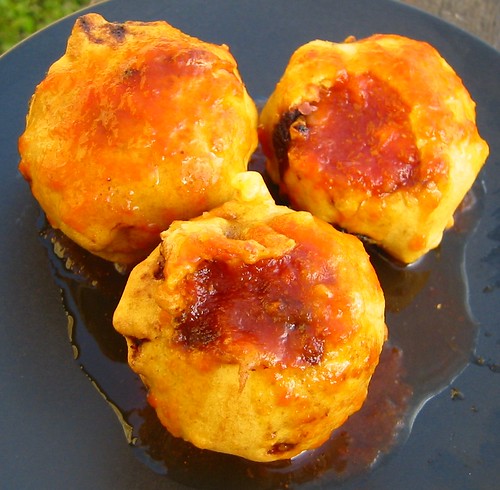
Tonight's dinner was such a failure that I really didn't want to share it but decided in the interests of painful truth and transparency to admit that once in a while I make a small error, sometimes, maybe, a bit.
If I were to tell you how I made these I'd have to kill you but if you're determined to have a go set your search engine for Bondas, for it was these delectable treats I based my disaster upon. My advice? Don't try to use up leftovers, it'll only end in tears.
However, having made my supper I ate it and what made that possible was the coating of sweet spicy tomato sauce I poured over the deep fried lumps while they were still hot.
In fact, I've spent a long time working on this sauce or ketchup or even, if you like, tomato jam as part of the autumn task of preserving the tomato crop for winter.
It's a lot of work for a scant 800ml* of sauce but the flavour is good. If you have a lot of tomatoes, or they're cheap at the market give it a go. You have only most of the day to lose.
Sweetly Hot Tomato Ketchup.
2kg tomatoes, green stems and bad parts removed.
25g or so fresh ginger root, grated.
4 or 5 cloves
Cinnamon stick, about 4 cm.
Dried red chillies, to taste. I used three.
4 cloves garlic, crushed.
15g salt
250g sugar (white is fine)
250ml 6% vinegar (I used a red wine version because I'm in France but white malt would do)
Put everything except the sugar and vinegar in a pan, put the lid on and bring to a simmer over a gentle heat for 45 minutes or so. The tomatoes will release their juice and cook in it. Allow to cool with the lid on the pan.
Run the whole lot through a mouli or food mill (or press through a fine sieve) to remove the tomato skins, lumpy bits and spices. You will have a quantity of thin, flavoured tomato juice.
In a cleaned pan, put the juice, sugar and vinegar and bring back to simmer. Stirring frequently, allow to reduce until the spoon leaves a short lived clean line on the bottom of the pan after a straight stroke. The sauce should now be about the thickness of ketchup. This may take a couple of hours or more. If the heat is too high and your attention is distracted it will probably burn. Bottle into hot sterilised jars and seal with vinegar proof lids immediately. Should keep for a year but probably won't as it gets eaten very quickly once opened.
* It might not have been quite such a meagre yield had I not raided the pan to douse my Bondas, but a girl has to eat.
First published 3/9/2008 A load of balls
==============================================
Tonight's dinner was such a failure that I really didn't want to share it but decided in the interests of painful truth and transparency to admit that once in a while I make a small error, sometimes, maybe, a bit.
If I were to tell you how I made these I'd have to kill you but if you're determined to have a go set your search engine for Bondas, for it was these delectable treats I based my disaster upon. My advice? Don't try to use up leftovers, it'll only end in tears.
However, having made my supper I ate it and what made that possible was the coating of sweet spicy tomato sauce I poured over the deep fried lumps while they were still hot.
In fact, I've spent a long time working on this sauce or ketchup or even, if you like, tomato jam as part of the autumn task of preserving the tomato crop for winter.
It's a lot of work for a scant 800ml* of sauce but the flavour is good. If you have a lot of tomatoes, or they're cheap at the market give it a go. You have only most of the day to lose.
Sweetly Hot Tomato Ketchup.
2kg tomatoes, green stems and bad parts removed.
25g or so fresh ginger root, grated.
4 or 5 cloves
Cinnamon stick, about 4 cm.
Dried red chillies, to taste. I used three.
4 cloves garlic, crushed.
15g salt
250g sugar (white is fine)
250ml 6% vinegar (I used a red wine version because I'm in France but white malt would do)
Put everything except the sugar and vinegar in a pan, put the lid on and bring to a simmer over a gentle heat for 45 minutes or so. The tomatoes will release their juice and cook in it. Allow to cool with the lid on the pan.
Run the whole lot through a mouli or food mill (or press through a fine sieve) to remove the tomato skins, lumpy bits and spices. You will have a quantity of thin, flavoured tomato juice.
In a cleaned pan, put the juice, sugar and vinegar and bring back to simmer. Stirring frequently, allow to reduce until the spoon leaves a short lived clean line on the bottom of the pan after a straight stroke. The sauce should now be about the thickness of ketchup. This may take a couple of hours or more. If the heat is too high and your attention is distracted it will probably burn. Bottle into hot sterilised jars and seal with vinegar proof lids immediately. Should keep for a year but probably won't as it gets eaten very quickly once opened.
* It might not have been quite such a meagre yield had I not raided the pan to douse my Bondas, but a girl has to eat.
Thursday, August 20, 2015
Nip them in the bud

It seems the much revered Nigel Slater has decided to jump on my bandwagon with a courgette recipe in the Guardian. I quite like the boy, I've even bought one of his books if only to give away, and although I might give his effort a try, for me it falls into the category of why bother. Like all recipes where a bit of courgette is added to a winning recipe be it brownies, pasta sauce or in this case latkes and found to be good one wonders how much better the dish would be /without/ the courgette.
No, I've decided the only way to tackle the green menace (or yellow if you're fancy) is to catch them young, tie them in a bag filled with rocks and throw them .... no, no, no. Is to catch them young and cook them while they're small, tender and you can use up whole handfuls of them in one meal.
Stuffed courgette flowers, with or without a baby courgette attached are actually considered rather desirable, posh food for guests, worth going to a restaurant to enjoy without having the bother of making your own. And they're a delicacy easy to obtain from your own garden.
Pick the whole thing, fruit and flower (you can take fresh male flowers too, it's all good) as the flowers open so gloriously for the first time. Best picked just before use but if the weather is warm and they're needed for the evening pick them early and keep in the cool until you're ready.

They shouldn't need much cleaning, shake out any insects and wipe the courgette part with a bit of damp kitchen towel. Carefully remove the style - the sticky up bit in the middle of the flower - which is easiest by nipping it out between finger and thumb but by all means use scissors or a sharp knife if you prefer. Try to keep the petals as unbroken as possible.
It's not necessary to slice and fan the baby fruit as I have done in the picture but it was once done like that for me when I had them in a fashionable restaurant at an impressionable age and so I always do them that way. It has some merit, allowing the vegetable to cook through more quickly.

As a starter or light snack you'd only need a couple per person and since they're deep fried it's probably better to do just that but I don't get the fryer out very often when I'm home alone and decided to indulge myself completely. In the picture then a couple of field mushrooms picked from the lawn, some entirely without heat chillies which are excellent for wimps like me and some pickles. I blame the Americans for that.
You don't have to stuff the flowers although it's often done; usually with a ricotta based stuffing. Make your favourite vegan alternative from commercial products or cashews or go off-piste as I did with an ad-hoc (this is a very verbose post!) mixture of what have you. I had some cooked green beans cut small with some grated vegan cheesley and some finely chopped sage bound with a little soya yoghurt. Seasoned with plenty of pepper it worked much better than I expected.
Fill the flowers carefully with a teaspoonful or two of your mixture and gently twist the ends of the petals closed around the stuffing. Don't overfill.
Make a batter to taste. I would recommend the sort of Japanese tempura batter made with rice flour and chilled sparkling water with a few crushed rice noodles stirred through but I only had brown flour and beer lightened with a little gram flour (besan) and made quite thin.
Heat your oil to a medium heat so that the vegetables will cook before the batter burns, dip your veg. into the batter, swirl to coat and allow the excess to drip off before settling them in the oil and frying until golden and crisp. Remove from the oil, drain briefly on kitchen paper and serve immediately. All that greasy goodness will need a dipping sauce, chutney or some nice fresh salsa with it.
That's the way to do it.

Wednesday, August 05, 2015
Spiraliser

The project could be going better. These are just a few of the ones that got away, the elephants in the room which I can't bear to acknowledge, without dissimulation, the marrows.
Today I decided to attack the problem with sharp blades. You'll see a lot of courgette noodles or spaghetti on the internets. They are the darling of raw foodies, dieters and those utterly weird people pursuing the paleo diet. How anyone could imagine that hunter gatherers had time to turn their veg into shreds confuses me but I don't have to worry about that because I am of the modern age and the modern age has spiralisers.
Even so, I have a bit of a problem with raw courgette - there's something about them that my insides just don't like and it's rare to find a recipe that will allow me to eat them with equanimity. So I chose a sauce that would, like the lime juice on ceviche, provide a gentle modification to them similar to cooking.

A single eight incher (that's about 20cm) if you'll pardon the expression was enough for the two of us. If you don't have a spiraliser you're probably stuffed for this recipe but desperation and a sharp peeler might do the business adequately.
The sauce is a very loose interpretation of a saté sauce, made with peanut butter, tomato passata and a little chilli oil, ginger and garlic but worked well to mask the courgette flavour. On the other hand my companion, the erstwhile Mr. Stripey, claimed to quite like the subtle and complex flavours of the raw vegetable although it didn't stop him finishing the sauce with a spoon.

Serve with bread and a fizzy wine for the full Normandy experience. I'd do it again but not soon.
For:
1 20cm courgette, spiralised or shredded finely
Sauce:
1 tablespoon of peanut butter
1 tsp grated ginger
1 small clove of garlic, crushed finely
1 tbs. wine vinegar
Juice of half a lemon
Splash of toasted sesame oil
Smaller splash of chilli oil (or to taste)
100g good passata
Salt as needed.
Mix everything for the sauce except passata and salt together until it is smooth, then add tomatoes, mix well and salt to taste.
Combine sauce and courgettes at the table or the courgette will release moisture and make the sauce too wet.
Saturday, July 25, 2015
Utterly Simple Pie
You'd think that having some visitors would help control the courgette mountain but the Stripey kittens, for it was they, are not huge fans of the vegetable. The boy kitten went so far as to say he hated the wretched things and would not eat them.
I ignored that and made this regardless. We had the extra benefits of a greater variety of herbs to flavour it and hunger being a fine sauce for appetite it was all eaten up, even by the courgette hater. Simpler really is best.
First published in August 2009 Something for the Courgettes
============================================
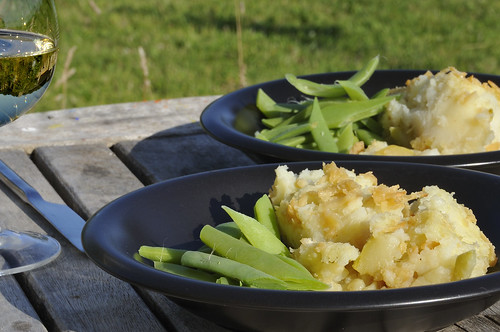
This year, I thought cleverly, I'll only have one courgette plant. That way they will never overwhelm me. How stupid was that! Even with two of us here we are slowly being taken over by sinister cucurbits. Last night it was time to take action.
They make an easy and light family meal if you slice them thinly, sweat down with an onion and herbs until softened and toss in a handful of chopped fresh tomatoes or mushrooms, whatever you have.
Put them into an ovenproof dish and top with mashed potato. Cover the mash with grated vegan cheese, breadcrumbs, crushed nuts or nutritional yeast, any, all or a mix of what you fancy and a drizzle of oil. Then cook in the middle of a hot oven until golden and fragrant.
Serve with green beans (thistle fluff optional!) and a nice Chablis.
I ignored that and made this regardless. We had the extra benefits of a greater variety of herbs to flavour it and hunger being a fine sauce for appetite it was all eaten up, even by the courgette hater. Simpler really is best.
First published in August 2009 Something for the Courgettes
============================================
This year, I thought cleverly, I'll only have one courgette plant. That way they will never overwhelm me. How stupid was that! Even with two of us here we are slowly being taken over by sinister cucurbits. Last night it was time to take action.
They make an easy and light family meal if you slice them thinly, sweat down with an onion and herbs until softened and toss in a handful of chopped fresh tomatoes or mushrooms, whatever you have.
Put them into an ovenproof dish and top with mashed potato. Cover the mash with grated vegan cheese, breadcrumbs, crushed nuts or nutritional yeast, any, all or a mix of what you fancy and a drizzle of oil. Then cook in the middle of a hot oven until golden and fragrant.
Serve with green beans (thistle fluff optional!) and a nice Chablis.
Subscribe to:
Posts (Atom)