Sunday, June 29, 2008

Pissaladière


Sorry for the short interruption in posting. Mr. Stripey Cat has been here and very sadly the poor old Black Cat has died. We've been a bit quiet and miserable.

This pissaladière is a variation on tradition, the well known version from Southern France includes anchovies, olives and sometimes capers on the onion topping. This one has mushrooms and some strips of roasted red pepper for garnish. It also forms another entry in my informal series of 101 things to do with a sheet of ready rolled puff pastry.

Chop plenty of onions, any sort will do and cook very gently in plenty of olive oil and a good grinding of black pepper until they are very soft and beginning to turn golden. Stir in some fresh thyme leaves stripped from their woody stalks. Remove the mixture from the pan and set aside to cool. In the same pan quickly fry off some fresh white mushrooms so that they take on a golden glow and lose a little of their moisture.

On a greased baking sheet, unroll your puff pastry. Spread the onions over it to within 25mm of the edge. Top with mushrooms. I used some lemon thyme for herby seasoning and it was o.k. but I think I'd stick to the more usual form in future.

Decorate with thin strips of roasted red pepper. If you have none you can lightly fry off strips of a fresh one before starting assembly.

Cook at about 200C for 25 minutes until puffed and golden. Serve with a green salad and a good chilled rosé.

Tuesday, June 24, 2008

Salad Plate

lighten up

Although anyone who knows me well will find this difficult to come to terms with I'm off my food this week. A combination of warm weather and anxiety in the trough of a depression has stolen my appetite and with it any inspiration I may have had for inventive cookery.

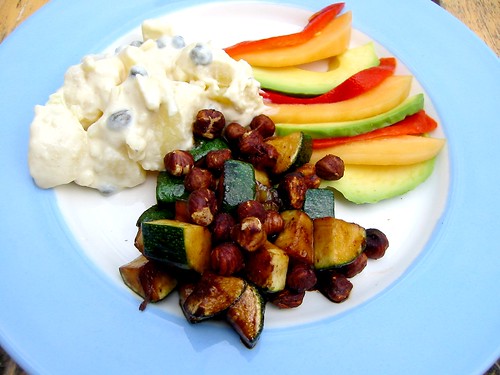
Still, I like to be thrifty and I have freshly dug potatoes and a pot of soya yoghurt that needed eating up. I made a potato salad with a dressing of mustard enhanced yoghurt and some capers.

I also have many courgettes. Some toasted hazelnuts, which would tempt the dead to eat, and a drizzle of balsamic vinegar on some lightly stir fried cubes of courgette made another simple salad.

Finally, a tricolour of avocado, melon and marinated roast red pepper makes the plate look pretty.

And since even the photograph looked dejected and flat I've bumped the contrast dramatically which is what gives it that rather interesting 50s colour plate look.

Bon Appétit

Monday, June 23, 2008

Bread with Beer in it


The perfect solution to the vegan need for soda bread without the buttermilk, soda bread with beer in it instead.

This is a profoundly easy and extremely nice quick loaf that slices, toasts and would probably make excellent 'eggy bread' (I think some people call this French toast) although I've not tried that yet. The texture is firm on the outside, tender within and it keeps for a day or two wrapped in a clean cotton teatowel. Rather nicer than all the Irish soda breads I've tried over the years if the truth be told.

When I first read a recipe for it on Farmgirl Fare it seemed to call for extra flavourings and fat in the form of added cheese and egg washes so when I came to veganise it I added nutritional yeast, garlic powder, herbs all of which things did nothing to improve the quality and in the case of the nutritional yeast flakes (I blame that Gayelord) contributed an unpleasant bitter flavour. So the next time I tried it I gave all those extras the push and kept it simple, and that worked.

400g fine wholemeal flour
400ml beer, I used a german lager, these are usually vegan, it would be nice to try this with a wheat beer sometime.
25g brown sugar
1/2 tsp salt
1 sachet (11g) baking powder.

Heat the oven to 200C. Mix all the dry ingredients together then add the beer and mix quickly into a thick batter. Make sure you stop mixing as soon as all the flour is incorporated.

Pour and scrape the mixture into a greased large loaf tin and cook for 55 mins to an hour. Test with a skewer to make sure it's cooked through, remove from oven and allow to cool on a rack for a few minutes before slicing.

Sunday, June 22, 2008

Polenta e minestra

greens and garlic

A bit of Italian for Sunday. This is one of the dishes that interested me when I read the cookbook; The Vegeterranean recently. What was particularly intriguing was the method they used to create the polenta croutons but when it came down to it, I didn't actually try that out today not least because the recipe says it will serve 8 and I'm on my own now until next weekend.

A quick whirl around the web (I wish I had my copy of the Silver Spoon here) is enough to assure me that this is a very well established dish originating in the poorer parts of Italy but none the worse for that. It's filling, delicious and cheap, which are all good things.

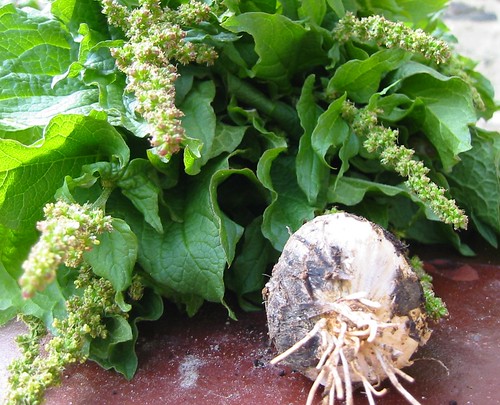
In my garden I have an unusual vegetable, Good King Henry, a sort of chenopod that has been first gathered and then cultivated for millennia as a sustenance food crop. As a substitute you can use any greens in season, from spring cabbage to spinach, chard, callaloo, kale or foraged greens like nettle tops and wild sorrel, all you need to do is adjust the blanching time according to the quality of your vegetables. I also used the first garlic bulb of the new season. Lucky me.

Polenta Croutons:

75g quick cook polenta (or traditional polenta and cook it longer!)
600ml cold water.

Mix the polenta with the water, bring slowly to a simmer, stirring continuously and cook for 3 or 4 minutes, then turn out into a wetted shallow dish or tin so that it is between 1 and 2 cm thick. Smooth the top, allow to cool and firm up for an hour or two before the next step.

Turn the polenta sheet out onto a cutting board and make neat cubes of it. Drizzle a little olive oil over the top and gently turn the cubes about in it until they are coated in oil. Lay them out on a tray and bake in a hot oven for 30 minutes to an hour (depending on the oven temperature, they easy to cook at the same time as something else). They will turn golden and crisp up a bit on the edges.

Minestra:

Take a handful of greens and cut into large shreds. Blanch the greens in a large pan of salted boiling water until they are softened. This will be quite quickly for tender cabbage, much longer for tougher veg. like the Good King Henry. I gave mine five full minutes. Spinach should be wilted in its own washing water, no extra needed.

Chop some garlic, to your taste, and a chilli (I didn't have one and used some shreds of red pepper and some chilli flakes). In a frying pan cook the garlic and chilli in a splash of olive oil until just beginning to colour, add your drained greens and stir all around. Finally (for 1 or 2 people) add 300ml of tomato stock (see below) or another vegetable stock, even made of your favourite stock powder, and let everything simmer for a moment to combine the flavours. Taste for salt and add some if needed.

Put polenta cubes into a deep soup bowl and top with the soup and abundant greens.
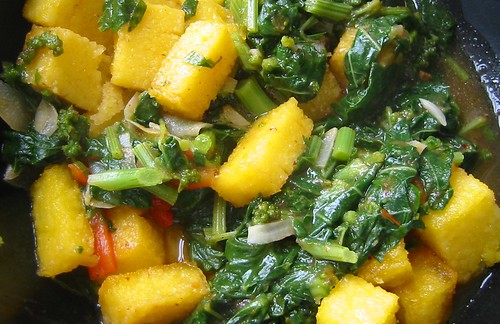
polenta e minestra

Tomato Stock or Broth:

4 large tomatoes, overripe is o.k.
600ml water
1 small onion
1/2 teaspoon salt

Chop the tomatoes up, skin, seeds and all and put them in the stock pan with the water, chopped onion and salt. A few celery leaves or a sprig of lovage may be added but don't overdo the flavourings.

Bring to a simmer and let cook gently with the lid on the pan for twenty minutes or so. Blend with stick blender and strain through a fine sieve. Yield: about 1 litre.

Saturday, June 21, 2008

Seven Vegetables

7 vegetable couscous

Last night I made Seven Vegetables Couscous for my visitors. It's a rather easy meal that allows for chatter and distractions during the cooking which was just as well, I'd not seen Chris and Martyn for months and received a couple of phone calls while I was cooking as well.

The seven vegetables bit is almost poetic, you can vary them at will and make your own mind up whether garlic counts as a herb or vegetable as required. We had the basic essentials of onions, tomatoes and chickpeas, with potatoes (Stroma from the garden), courgettes, carrots and garlic. Other nice additions are green beans, aubergine, celeriac, pumpkin, what have you really. The tomatoes can be fresh or tinned. The chickpeas should be cooked beforehand (or use a tin).

Chop everything into bite sizes, fry off the onion and garlic in some good olive oil, add the rest of the vegetables, a little water and let everything stew. The seasonings are a piece of cinnamon stick, cumin, ground black pepper, hot pepper flakes to taste, parsley, sage, rosemary, thyme (or any combination thereof) and a final addition of some chopped green coriander just before serving. Harissa is traditional but optional.

I don't have a steamer here so used instant couscous made with boiling water, allowed to swell and then fluffed up with a fork and some melted margarine.

Thursday, June 19, 2008

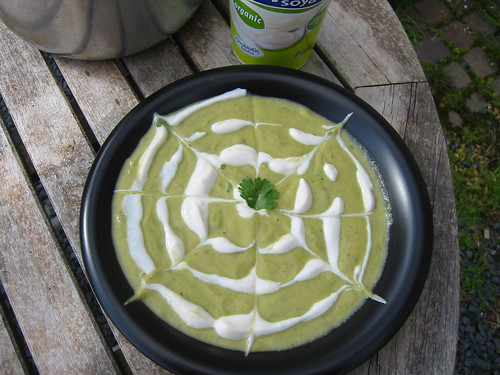
creamy courgette herb soup

creamy courgette herb soup

There is no explanation for what possessed me to buy a net bag of courgettes last time I went shopping. I have six plants in the patch and they are just about to come onstream. I must be mad.

Anyway, this is a delightfully rich tasting soup which is very low in fat and a good way of making use of garden excesses.

Finely chop an equal number of medium sized onions and courgettes. I used two of each and have enough soup for four...

Sweat the onions down in just a touch of oil, your choice and then add the courgette slices. Put the lid on the pan and leave over a low heat until the courgettes are very soft.

Early season courgettes are very different to the 'almost marrows' of later in the season. They're much denser and contain less liquid. At this time of year you'll need to add somewhere between 300 and 450ml of water to this quantity of soup to get a good consistency, but this will become less as the summer goes on until at the start of autumn you may need no water at all.

Start with 300ml and see how it goes. Let the soup cook for a few minutes more with the liquid added and then use an immersion blender to render it into a wonderful smooth puree. You may need to add a little more water as you go but it should be fairly thick, a thin soup will taste of nothing. Test for seasoning, it will need a pinch of salt.

Put the pan back on the heat to warm up again and as it reaches a simmer toss in a good handful of finely chopped fresh and dry green herbs. I used coriander and mint but parsley, basil, chervil, even a few sprigs of tarragon would all be good. Experiment.

I put some soya yoghurt on mine to make the pretty pattern but it was a little bit thick. If you want to do this I'd recommend you thin the yoghurt first very slightly with a drop of soya milk or water. Alpro isn't available anywhere in France I know about, this was part of a care package brought over by Mr. Stripey Cat.

Serve your soup with something crunchy to accentuate the unctuousness of the herby cream.

Tuesday, June 17, 2008

Almost not cooking at all

stir fry

I exhausted myself with all that poncey stuff yesterday. Tonight's supper is rather more pragmatic; a stir fry sort of thing with vegetables to hand, courgette, onion, left over aubergine sides, odd beet shoots mixed with tinned sweetcorn and chickpeas and seasoned with a mighty gloop of soy sauce and some black pepper. It was served on a deep bed of chopped lettuce, something that the garden is threatening to overwhelm me with.

Seasoned on the plate too, this time with tabasco pepper sauce. Every artist needs time to recharge.

Monday, June 16, 2008

Mediterranean Maki

medmaki
Aubergine rolls of seasoned rice with a centre of sundried tomatoes, served with a Black Olive tapenade and Egyptian Beet salad.

First make your tapenade:

Stone 10 fat black greek cured olives. Add to them a teaspoonful of capers and a crushed clove of garlic. Mince finely together with a very sharp knife. You could use a blender or processor but this is such a tiny quantity it would be wasteful. When nicely amalgamated, add a pinch of dried oregano, a few thin shreds of preserved lemon in fine dice and two teaspoons full of olive oil. Mix together well. Cover and store in cool place until needed.

For the rolls:

Rehydrate five or six dried tomatoes (or use oil packed) and slice into very thin shreds.

Cook 200g of a shorter grained rice. I used a brown rice but rice from the Camargue or Valencia would be a nice touch. When it's cooked turn into a wide shallow bowl and add the seasoning mix of; 1 tsp. sugar and 1 (or half) tsp. salt dissolved in a very little hot water. Add 2 tbsp. mild vinegar. Stir this into the rice, fanning as you go to cool it. Cover and set aside until needed.

The aubergine wrapper is made from very thin slices of aubergine, cut lengthways. You will need nine neat slices, each one not more than 3 mm thick and you should be able to get these from one large fruit. Save the lumpy sides for another meal and concentrate on getting those slice from the fleshy central part.

Lightly salt the slices and leave for half an hour to degorge, then pat dry.

In a hot pan with just a very few drops of oil (if you have a spray use it) cook each slice until softened and slightly browned. Don't let them get crisp. Remove each slice to a piece of kitchen paper to drain while you cook the others. This isn't a difficult step but it pays to be careful and neat while you work. Don't let the slices crumple up too much.

On your sushi rolling mat (or a piece of clingfilm) arrange the cooked slices neatly so that they overlap a little and make a continuous sheet of sliced aubergine. This is your equivalent to the seaweed in a Japanese roll. Spread a layer of rice over half the sheet along the longer side, you won't need all of it, and then a line of shredded tomato along the middle of the rice. Roll up as tightly as you can, wrap tightly and set in the fridge to chill until serving.

To serve:

Dress your beet shoots (I use garden thinnings but small packs of sprouts can sometimes be bought) with a little olive oil and salt if required.

Unwrap your roll and with an extremely sharp knife make neat sections. The ends won't be very good but you will get 7 or 8 pieces. Arrange on serving plate(s) with a small mound of tapenade and a little pile of leaves.

medmaki2

Sunday, June 15, 2008

Sweet Bricks


Sweet Samosas made with Brick.

Three left over sheets of Brick made six little sweet samosas, two filled with strawberries, two with chocolate and two with date and preserved lemon. I liked the date and lemon version best.

Saturday, June 14, 2008

Rocket powered

My rocket is abundant and starting to flower. I thought I'd tame it by turning it into pesto.

Then I remembered my old food processor is no more, the mini-hachette would need to be loaded a million times and I have no pestle and mortar. Yes, that's right, no pestle, no mortar. It's a blow.

Anyway, that meant instead of delightfully raw green sauce for my spaghetti I had to settle for this lightly wilted one instead.

Get your pasta water on, plenty and well salted. As soon as it's boiling, stick the spaghetti in and cook until it's how you like it.

Meanwhile, chop a potato into small dice and put into a generous but not excessive gloop of hot olive oil. I used a raw one but if you had a cooked one leftover it would be fine to use. Let it fry gently for a while until cooked through and beginning to colour.

Add a green onion, bulb and leaves, chopped reasonably finely. Stir it into the hot potatoes and turn off the heat. Season well with ground black pepper.

Chop a really big bunch of dry rocket with a very sharp knife into fine shreds and then cross cut to make it even smaller.

When your pasta is cooked, drain it, retaining just a little water.

Turn the heat under the potatoes back on again, throw in the rocket and stir fry until it's softened and reduced in volume, then add the pasta, toss well, adjust seasoning and serve.

rocket pasta

I thought this treatment gave the rocket a slight taste of seaweed, an observation in molecular gastronomy that might repay investigation at another time.